Benefits of Journaling for Emotional Clarity
Emotions are rarely simple. What feels like anger may contain grief. What looks like indifference may be exhaustion. Journaling helps you sort through the tangle, separating one feeling from another until you can see each one clearly. This clarity does not come from thinking harder. It comes from writing honestly, night after night, and letting the truth surface at its own pace.
Key benefits
Untangles complex emotional states
Many of the feelings you carry through the day are layered. A single conversation might leave you feeling relieved, guilty, and sad all at once. Writing about it allows you to tease apart these layers, giving each emotion its own space on the page and its own weight in your understanding.
Sharpens your ability to name what you feel
Precision matters in emotional life. There is a difference between feeling lonely and feeling unappreciated, between boredom and restlessness. The more you practise putting feelings into specific words, the more accurately you understand your own inner landscape. This accuracy is a form of care.
Reveals the roots beneath surface feelings
A moment of sudden frustration may trace back to something you have been carrying for days. Journaling gives you the space to follow a feeling to its source, moving from the surface reaction to the deeper current beneath. What you discover there is often simpler and more tender than you expected.
Supports clearer communication with others
When you understand what you feel, you can express it more clearly to the people who matter to you. A journal is where you do the private work of sorting through your emotions so that your conversations can be more honest and less cluttered by confusion.
What the evidence suggests
Research in affective science has demonstrated that emotional granularity, the ability to draw fine distinctions between emotional states, is associated with better mental health outcomes and more effective coping strategies. Studies suggest that individuals who can precisely label their emotions are less likely to respond to distress with maladaptive behaviours such as avoidance or aggression. Evidence from expressive writing research indicates that the process of articulating emotions in written form enhances this granularity over time, as the act of choosing words requires a level of specificity that internal reflection often skips. Neuroscience research further supports this, showing that precise affect labelling reduces amygdala reactivity and promotes prefrontal engagement.
Putting it into practice
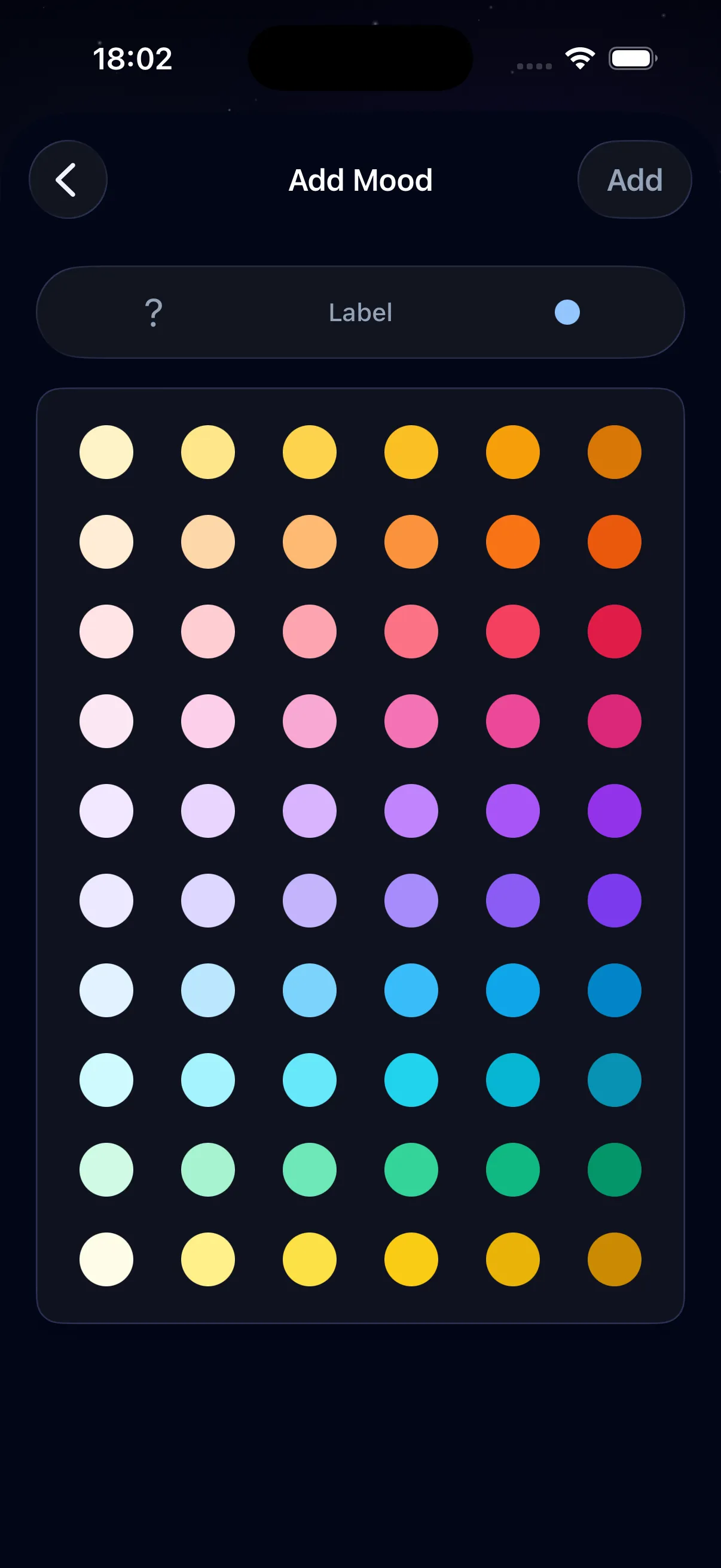
When you sit down to write in the evening, resist the first word that comes to mind for your emotional state. Our guide to journaling for emotional processing can help you develop this precision. Self-reflection prompts offer questions that gently push beneath the surface. If you were about to write that you feel fine, ask what fine actually means tonight. If the answer is tired but content, write that instead. Push gently toward specificity. Describe not just the emotion but its texture, its weight, whether it sits in your chest or your throat. In Nightbook, the mood you choose colours your star for that night, and over time your sky becomes a nuanced map of your emotional life. Looking up at it, you may notice patterns that words alone could never show you.
Prompts to explore this
- ★ What am I actually feeling right now, beneath the first word that comes to mind?
- ★ Was there a moment today when I felt something I could not quite name?
- ★ What emotion have I been avoiding this week, and what might happen if I let it in?
- ★ How do I typically express difficult feelings, and does that method serve me well?
- ★ If I could describe my emotional state tonight as a colour or a weather pattern, what would it be?
Keep exploring
Benefits
Turn your reflections into stars
Nightbook is a quiet journal for your evening thoughts. Every entry becomes a glowing star. Every week becomes a constellation.