What Is Burnout?
Burnout is what happens when sustained stress depletes you beyond ordinary tiredness. It shows up as deep exhaustion, emotional numbness, and a growing sense that nothing you do quite matters. It is not a sign of weakness. It is a signal that something has been asked of you for too long without enough replenishment.
A closer look
The term "burnout" was first used in a clinical sense in the 1970s by psychologist Herbert Freudenberger, who noticed it in healthcare workers. Since then, it has been recognised across all walks of life. The World Health Organisation now classifies it as an occupational phenomenon, though anyone who has felt it knows it reaches far beyond work. Burnout tends to arrive gradually. It begins with overcommitment, moves through frustration and fatigue, and eventually settles into a kind of grey flatness where even things you once loved feel like obligations. Sleep suffers. Patience thins. The benefits of journaling for stress become particularly valuable at this stage. The evenings that should bring rest instead fill with a restless, hollow tiredness. What makes burnout particularly difficult is that the people most prone to it are often the most dedicated. They care deeply, give generously, and struggle to set boundaries. Recognising burnout is the first step towards recovering from it, and that recognition often comes in quiet moments, late in the day, when the noise finally stops and you can hear how tired you really are.
Putting it into practice
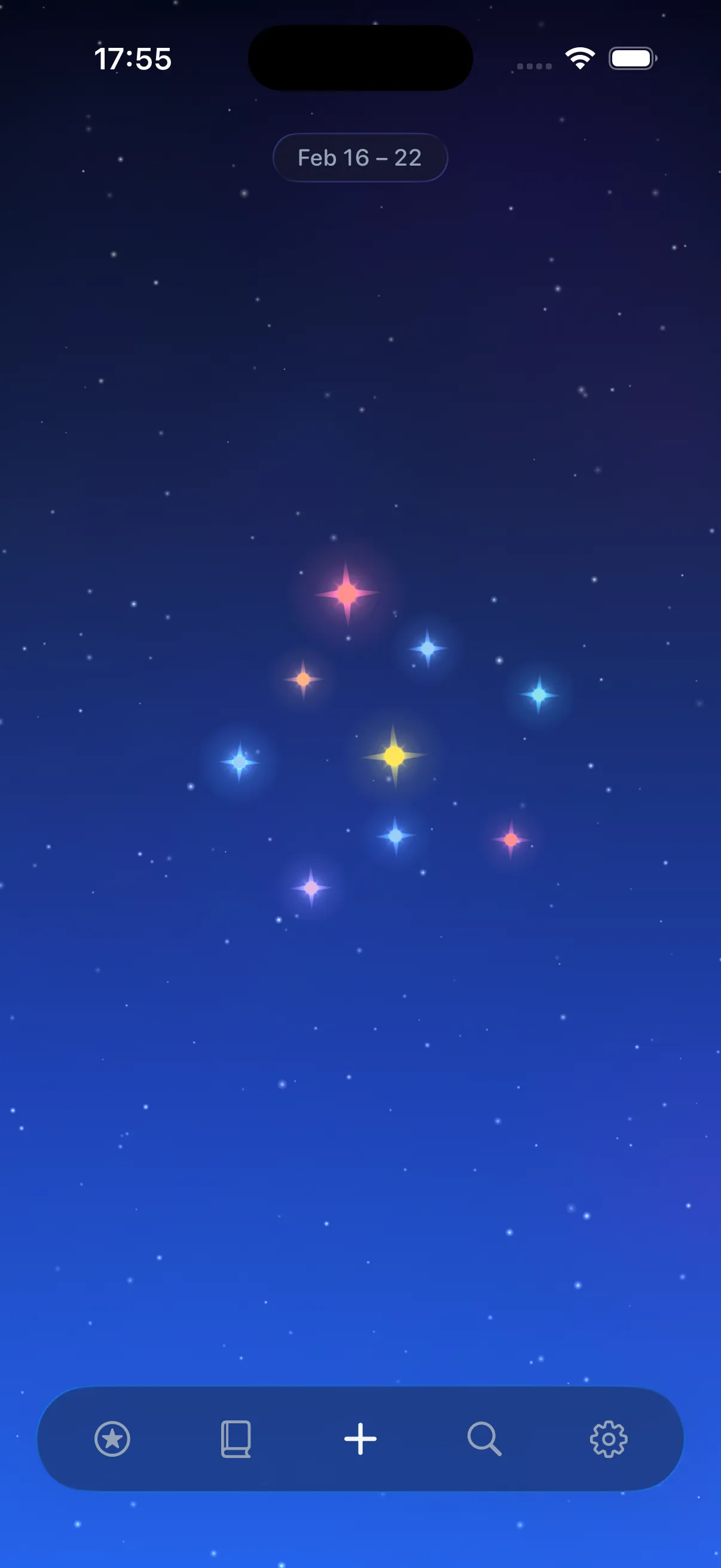
Recovery from burnout is slow and requires honesty. Start by acknowledging where you are, without judgement. An evening journal can be a safe place to do this, somewhere to write what you cannot easily say aloud. Mood journaling is a gentle way to begin — you might note your energy levels, what drained you, what small thing brought a flicker of warmth back. In Nightbook, tracking these reflections over time creates a constellation that tells a story. You may begin to see what pushed you towards depletion and what helped you return. The ritual of writing a few words each evening is itself a form of recovery, a gentle boundary between the demands of the day and the rest you deserve. It will not fix everything, but it gives you a place to begin.
Prompts to explore this
- ★ On a scale of empty to full, where is my energy tonight?
- ★ What have I been carrying that is not mine to carry?
- ★ When did I last feel genuinely enthusiastic about something?
- ★ What is one thing I could let go of this week without the world ending?
- ★ What would rest, real rest, look like for me right now?
Keep exploring
Methods
Benefits
Turn your reflections into stars
Nightbook is a quiet journal for your evening thoughts. Every entry becomes a glowing star. Every week becomes a constellation.