What Is Stream of Consciousness Writing?
Stream of consciousness writing is the practice of letting your thoughts flow directly onto the page without pausing to correct, organise, or censor them. You write as you think: one thought leading to the next, without a plan. It is a way of bypassing the inner editor and discovering what is actually on your mind.
A closer look
The term "stream of consciousness" was coined by psychologist William James in the 1890s to describe the continuous flow of thoughts and sensations in the human mind. Writers like Virginia Woolf and James Joyce adopted it as a literary technique, but as a journaling practice, it serves a different purpose. It is not about crafting beautiful prose. It is about access, getting underneath the surface thoughts to whatever is waiting below. When you write without stopping, something interesting happens. The first few sentences are often mundane, what you had for lunch, that you are tired, that you cannot think of anything to write. But if you keep going, the writing tends to deepen. You surprise yourself. Feelings you did not know you were carrying appear on the page. Connections form between thoughts that seemed unrelated. The stream of consciousness method explores this process in more detail. This kind of writing can feel messy and vulnerable. That is part of its value. It creates a space where you do not need to perform or present a tidy version of yourself. It is the journaling equivalent of stepping outside on a clear night and simply looking up: no map, no agenda, just the sky as it is.
Putting it into practice
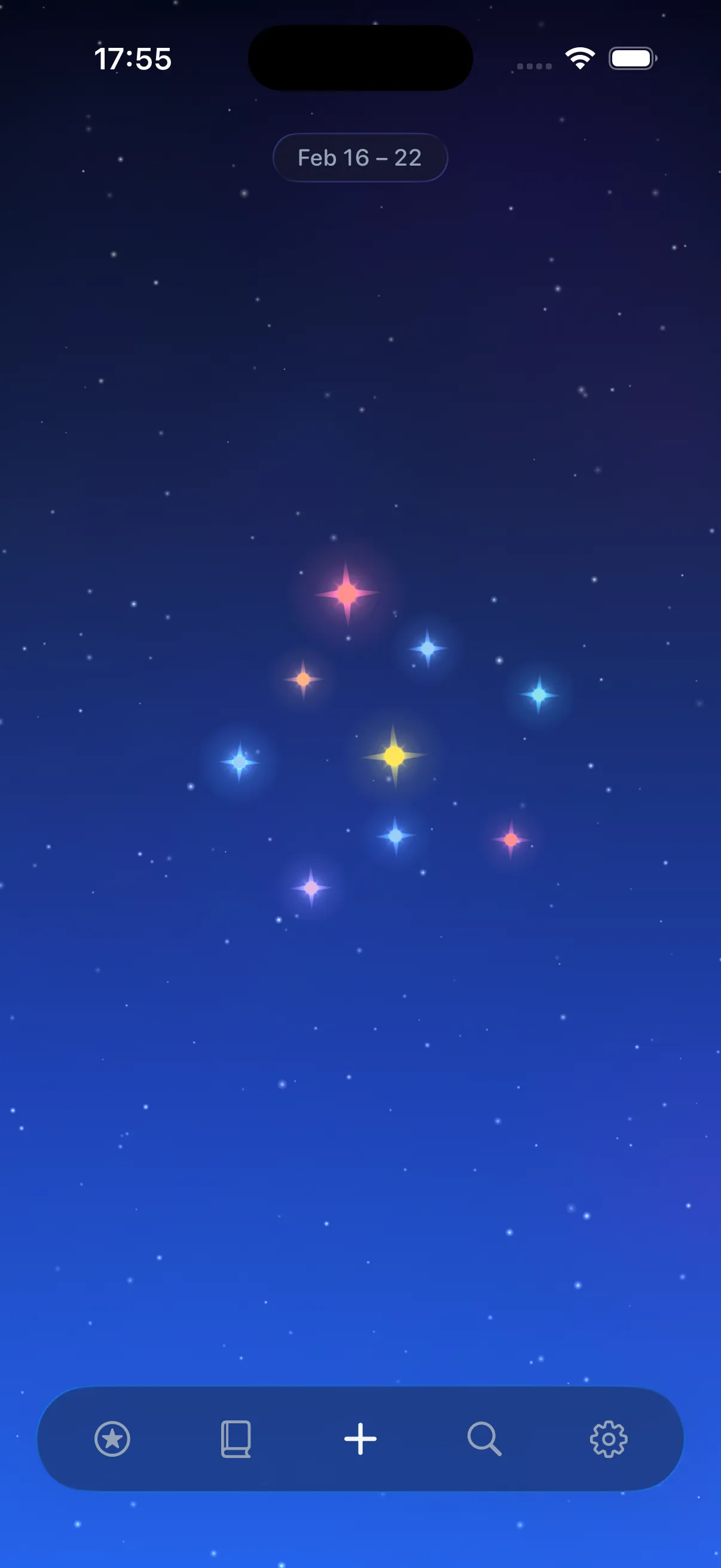
Set a timer for ten or fifteen minutes. Begin writing and do not stop until the time is up. If you run out of things to say, write "I don't know what to write" until something else arrives. Do not reread what you have written until the session is over: and even then, rereading is optional. If you prefer a similar practice with a specific structure, morning pages follow a comparable rhythm. Nightbook can be a quiet companion for this kind of writing. You might use the evening as your time to let thoughts pour out before sleep, releasing whatever the day has gathered. Each entry, however raw, becomes a star. You do not need to polish it. The sky holds everything, the bright and the dim alike.
Prompts to explore this
- ★ What is on my mind right now, before I try to make sense of it?
- ★ What feeling keeps surfacing that I have not yet named?
- ★ If I let my thoughts wander freely, where do they go?
- ★ What have I been avoiding thinking about?
- ★ What does my mind return to when it has nothing else to do?
Keep exploring
Turn your reflections into stars
Nightbook is a quiet journal for your evening thoughts. Every entry becomes a glowing star. Every week becomes a constellation.