How to Start Journaling
Starting a journal can feel oddly intimidating. The blank page carries a strange pressure, as though whatever you write needs to be profound or well-crafted. It does not. Journaling is simply the act of putting your thoughts somewhere outside your head. This guide will help you begin without fuss, so the habit can take root quietly and on your own terms.
Why this helps
There is a reason journaling appears in so many wellbeing recommendations. The act of writing slows your thinking down just enough to notice what is actually going on inside you. When thoughts stay in your head, they tend to blur together, looping and overlapping until it all feels like one heavy mass. Writing separates them out. You start to see which thoughts matter and which are just noise. Research into expressive writing has shown that even a few minutes of regular writing can reduce stress, improve mood, and help with emotional clarity. You do not need special skills. You do not need beautiful handwriting or a leather-bound notebook. You just need a willingness to sit with yourself for a few minutes each day and let the words come.
How to begin
Choose one time of day
Pick a moment that already exists in your routine, perhaps after dinner or just before bed. Attaching journaling to something you already do, a technique called habit stacking, makes it easier to remember. It does not need to be the same time forever, but starting with one anchor point helps.
Write without editing yourself
Your first entries do not need to be interesting or insightful. Write about what happened today, what you ate, how the weather felt. Let it be ordinary. The point is to build the muscle of showing up, not to produce something remarkable.
Set a small, manageable goal
Commit to three sentences, or two minutes, or half a page. Whatever feels almost too easy. A tiny goal removes the resistance that stops most people before they begin. You can always write more, but you never have to.
Let go of perfectionism
No one will grade this. Spelling mistakes, half-finished thoughts, crossed-out lines, all of it is fine. Your journal is a private space. The moment you stop trying to write well is the moment journaling starts to work.
Notice how it feels afterwards
After a few days, pay attention to the quiet shift. You may feel slightly lighter, a little more aware of your own patterns. These changes are subtle at first, like stars appearing as your eyes adjust to the dark. Let that be enough.
Things to keep in mind
- — You do not need a fancy notebook. A simple app like Nightbook or a plain notepad works perfectly well.
- — If you miss a day, just pick up again the next day. Gaps are normal and not a sign of failure.
- — Writing by hand and typing both work. Choose whichever feels less like a chore.
- — Try not to reread your entries for the first week. Just write and move on.
- — If you feel stuck, start with the words "Today I noticed..." and see what follows.
Prompts to try tonight
- ★ What has stopped you from journaling before now?
- ★ If you could write about just one thing tonight, what would it be?
- ★ What do you hope journaling might do for you, even in a small way?
- ★ How did it feel to write without worrying about getting it right?
- ★ What is one thing you noticed about yourself today that you might otherwise have forgotten?
Keep exploring
Guides
Benefits
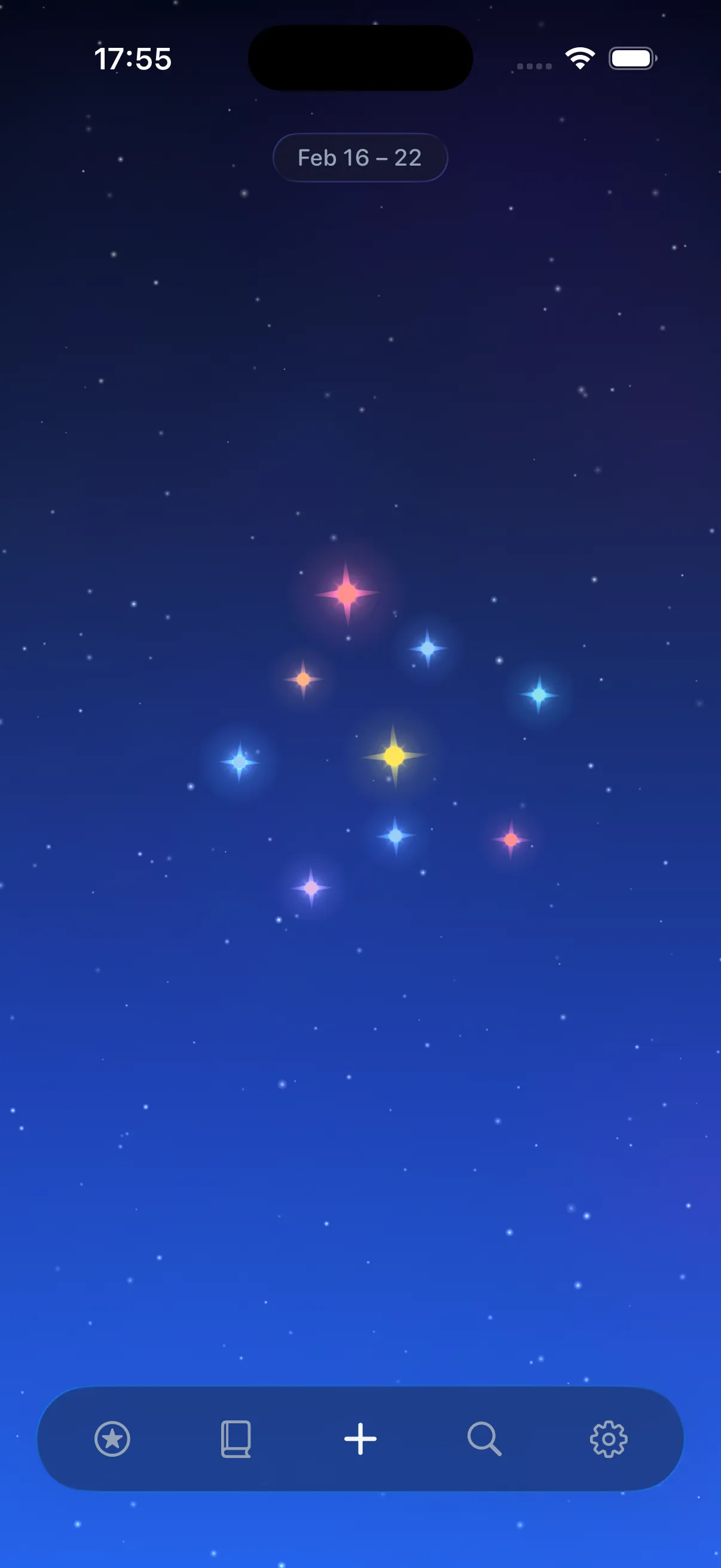
Turn your reflections into stars
Nightbook is a quiet journal for your evening thoughts. Every entry becomes a glowing star. Every week becomes a constellation.