How to Freewrite in a Journal
Freewriting is journaling with the filter removed. You write continuously, without pausing to think, correct, or judge. Whatever arrives on the page stays there, however messy or strange it looks. The practice works because it bypasses the part of your mind that wants to curate and control, letting you reach thoughts you did not know you had.
Why this helps
Most of the time, we edit ourselves before we even finish a thought. Freewriting suspends that habit. By committing to write without stopping, you create a kind of pressure that pushes past the surface. The first few sentences are often unremarkable, what you had for dinner, the weather, a complaint. But somewhere around the second or third minute, something shifts. The writing begins to surprise you. Ideas connect in unexpected ways. Feelings you had buried rise to the surface. This is not magic. It is simply what happens when you remove the gatekeeper. Psychologists have noted that uncensored writing can surface subconscious concerns and reduce the cognitive load of suppressed thoughts, building emotional clarity along the way. The page becomes a place where your mind can stretch out without being watched. Expressive writing research calls this the disclosure effect.
How to begin
Set a time limit
Choose a duration, five or ten minutes works well, and commit to writing for the entire stretch. A boundary makes the open-endedness feel safe. You know it will end, which makes it easier to let go.
Begin with whatever comes
Do not wait for inspiration. Start with the most ordinary thought you have. "I am sitting here and I do not know what to write" is a perfectly good opening. The content of the first line does not matter. Movement does.
Do not stop or correct
If you misspell a word, leave it. If a sentence makes no sense, keep going. The moment you pause to fix something, the internal editor wakes up and the freewriting loses its power. Let the mess be part of it.
Follow the thread
When a thought pulls you in an unexpected direction, follow it. Freewriting is not linear and it is not supposed to be. The surprising turns are often where the most useful material lives. Trust the wandering. Creativity prompts can offer a starting point when the wander does not come on its own.
Stop and sit with it
When the time is up, put your pen down or stop typing. Do not reread immediately. Sit for a moment with whatever surfaced. Some of it will feel meaningful. Some will not. Both are fine.
Things to keep in mind
- — Freewriting works especially well at night, when the conscious mind is tired and the guard is lower.
- — If you are stuck in a loop, write the same word repeatedly until something else breaks through.
- — Try not to reread your freewriting for at least a day. Distance changes what you see in it.
- — There are no rules about topic. You can shift from groceries to grief in the same paragraph.
- — Some of your most honest writing will happen this way. Let it be rough.
Prompts to try tonight
- ★ What came up in your freewriting that you did not expect?
- ★ Where did your mind go when you stopped trying to direct it?
- ★ Was there a sentence that surprised you with its honesty?
- ★ What were you avoiding writing about, and did it surface anyway?
- ★ How did it feel to write without any rules at all?
Keep exploring
Guides
Turn your reflections into stars
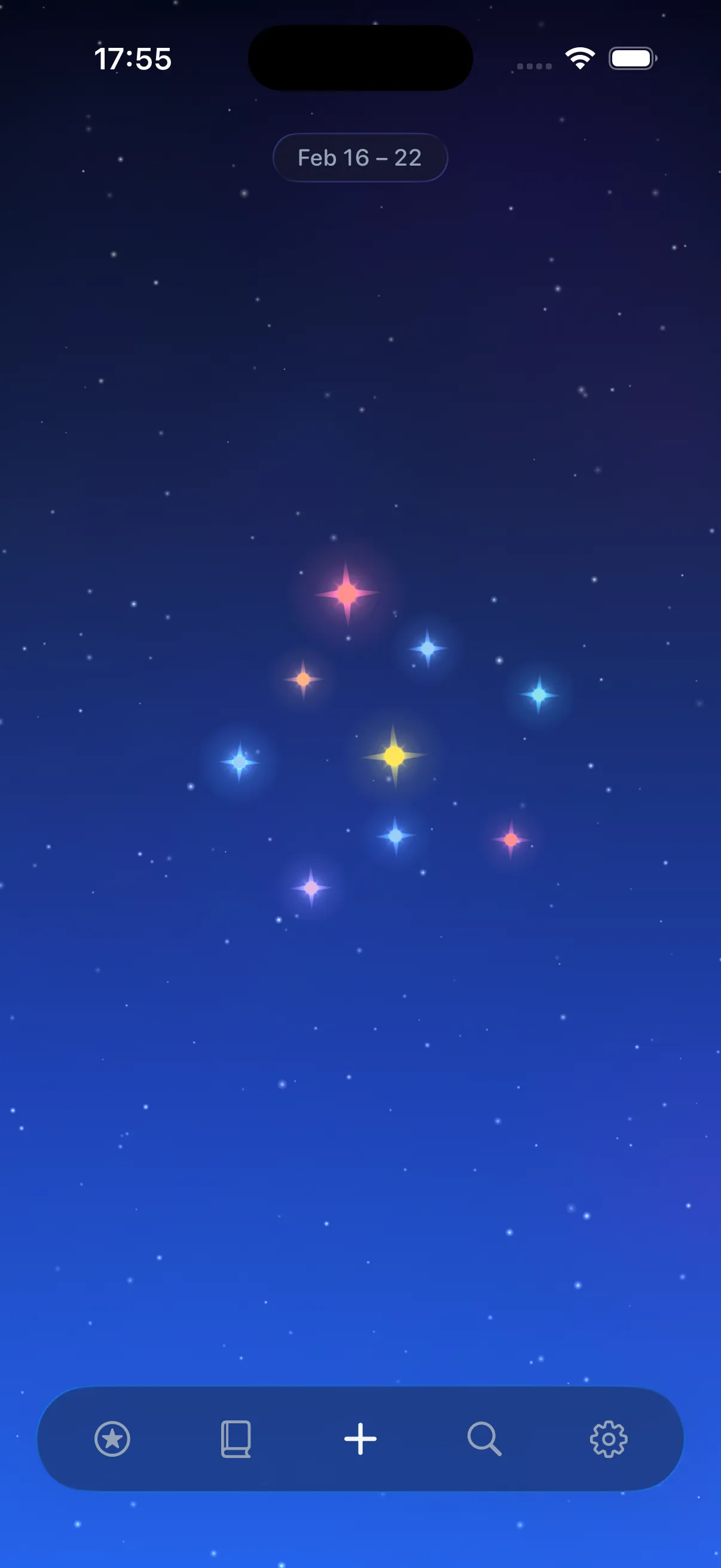
Nightbook is a quiet journal for your evening thoughts. Every entry becomes a glowing star. Every week becomes a constellation.