How to Journal About Relationships
Relationships shape us in ways we rarely pause to examine. The people closest to you influence how you feel about yourself, what you tolerate, and what you believe you deserve. Journaling about relationships creates a private space to look at these dynamics honestly, without the pressure of saying the right thing to anyone. This guide helps you use writing to see your connections more clearly.
Why this helps
Inside a relationship, it is difficult to see clearly. Emotions run high, history clouds the present, and your own needs can become tangled with someone else's. Writing creates distance, not from the person, but from the reactivity. When you describe a conversation on paper, you notice things you missed in the moment, the tone behind the words, the feeling in your chest you pushed aside, the pattern you have seen before. Journaling also helps you hear your own voice. In close relationships, it is easy to lose track of what you actually think beneath the layers of compromise and accommodation. The page does not argue back or change the subject. It lets you sit with your own perspective long enough to understand it. Over time, this clarity can quietly reshape how you show up in the relationships that matter most.
How to begin
Write about one relationship at a time
Rather than reflecting on relationships in general, choose one person and write about your connection with them specifically. What you appreciate. What confuses you. Where you feel safe and where you do not. Specificity brings honesty.
Describe moments, not conclusions
Instead of writing "they are selfish" or "we are fine," describe a specific moment that made you feel something. The detail of a scene reveals more than a summary ever could, and it is harder to dismiss when you see it on the page.
Notice your own part
Relationships are not one-sided, even the difficult ones. After writing about what the other person did or said, gently turn the lens toward yourself. How did you respond. What did you leave unsaid. What pattern of yours might be at play here. This kind of self-reflection is where relationships truly deepen.
Track the feeling over time
Write about the same relationship across multiple entries. A single snapshot can mislead. But a series of entries reveals whether a connection is growing, stagnating, or quietly eroding. Patterns across weeks are more trustworthy than any single argument or good evening.
Write what you cannot say
Some things are too fragile, too honest, or too uncertain to say out loud. The journal can hold them. Write the words you swallowed during dinner. The unsent letter method was made for moments like these. Write the question you are afraid to ask. These unspoken things deserve a place, even if they never leave the page.
Things to keep in mind
- — Be honest on the page, even when it feels disloyal. Your journal is not a betrayal. It is a mirror.
- — If journaling about someone brings up anger, let the anger be there. Do not rush to resolve it.
- — Writing before a difficult conversation can help you find your own position before you enter the room.
- — Not every relationship needs fixing. Sometimes journaling helps you accept things as they are.
- — Revisit old entries about a relationship before making major decisions about it.
Prompts to try tonight
- ★ Who are you thinking about tonight, and what feeling do they bring with them?
- ★ What is something you wish you had said today, to anyone?
- ★ In which relationship do you feel most like yourself, and what makes that possible?
- ★ What pattern keeps appearing in your closest relationships?
- ★ If you could change one thing about how you show up in relationships, what would it be?
Keep exploring
Guides
Turn your reflections into stars
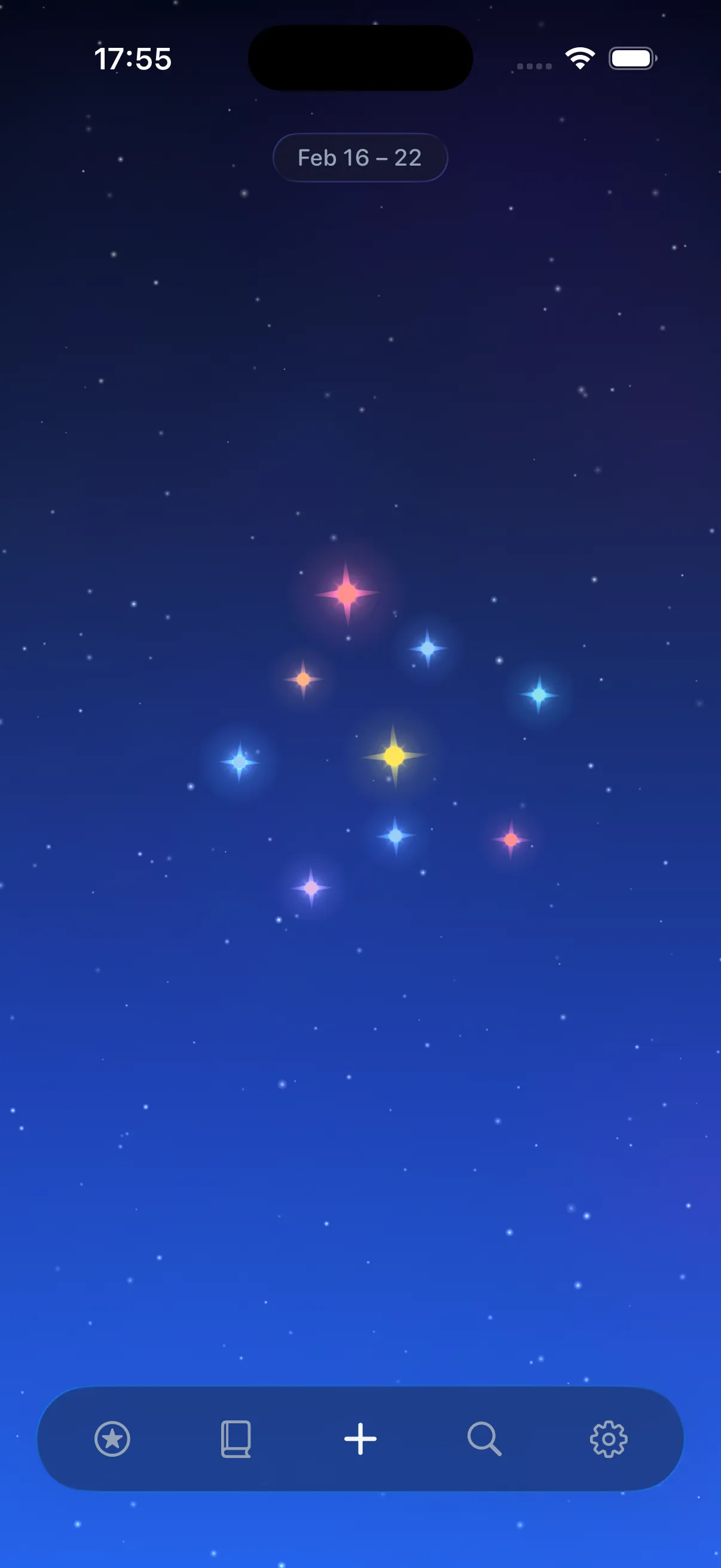
Nightbook is a quiet journal for your evening thoughts. Every entry becomes a glowing star. Every week becomes a constellation.