How to Journal with Prompts
A blank page asks everything of you at once. A prompt narrows the question just enough to give you somewhere to start. Journaling with prompts is especially helpful when you want to write but do not know what about, or when your thoughts feel tangled and you need a thread to pull. This guide shows you how to use prompts as gentle starting points rather than rigid instructions.
Why this helps
Prompts reduce the cognitive load of getting started. Instead of deciding what to write about and then writing about it, you only need to do the second part. This matters more than it sounds, because the decision of what to write is often what stops people from writing at all. A well-chosen prompt also has a way of reaching past the surface. It asks a question you might not have thought to ask yourself, and the answer that comes can be genuinely surprising. Over time, working with a variety of prompts builds a richer, more varied journal. The benefits of journaling for self-discovery are amplified when prompts push you beyond your usual terrain. Instead of circling the same three concerns each night, you find yourself exploring memory, values, relationships, and corners of your inner life that rarely get attention. The prompt is not the destination. It is the door you walk through to reach wherever you were actually meant to go.
How to begin
Choose a prompt that resonates
Browse a few options and pick the one that creates a small tug, a question that makes you curious or slightly uneasy. If a prompt feels too easy, it may not take you anywhere new. A little resistance usually means there is something worth exploring underneath. Prompted journaling as a method is built around this principle.
Write your first response quickly
Do not deliberate. Start writing within a few seconds of reading the prompt. Your first, unfiltered response is usually the most honest one. You can always go deeper, but begin with instinct rather than analysis.
Let yourself wander from it
A prompt is a starting point, not a cage. If your writing drifts away from the original question, let it. The most valuable material often appears in the tangents, in the places your mind goes when it thinks you are not watching.
Sit with what surfaces
After you finish writing, pause for a moment. Notice what came up. Was there an emotion you did not expect. A memory you had forgotten. A truth you had been avoiding. Give it a few seconds of quiet acknowledgement before you close the page.
Return to prompts that moved you
Some prompts are worth revisiting. The same question asked a month apart can yield completely different answers, and the gap between those answers shows you how you have changed. Keep a short list of prompts that resonated and cycle back to them.
Things to keep in mind
- — If no prompt feels right, write about why none of them feel right. That resistance is itself material.
- — Nightbook offers nightly prompts tailored to different moods, which can save you the effort of choosing.
- — Alternate between prompts that feel comfortable and ones that challenge you.
- — You do not need to answer the prompt directly. Sometimes it is enough to circle around it.
- — Try using the same prompt for a week straight and notice how your answers shift.
Prompts to try tonight
- ★ Which question are you most reluctant to answer honestly, and why?
- ★ What is a memory that keeps returning to you, no matter how much time passes?
- ★ If you could ask your future self one question, what would it be?
- ★ What do you believe about yourself that you have never written down?
- ★ What would change in your life if you were completely honest with yourself tonight?
Keep exploring
Guides
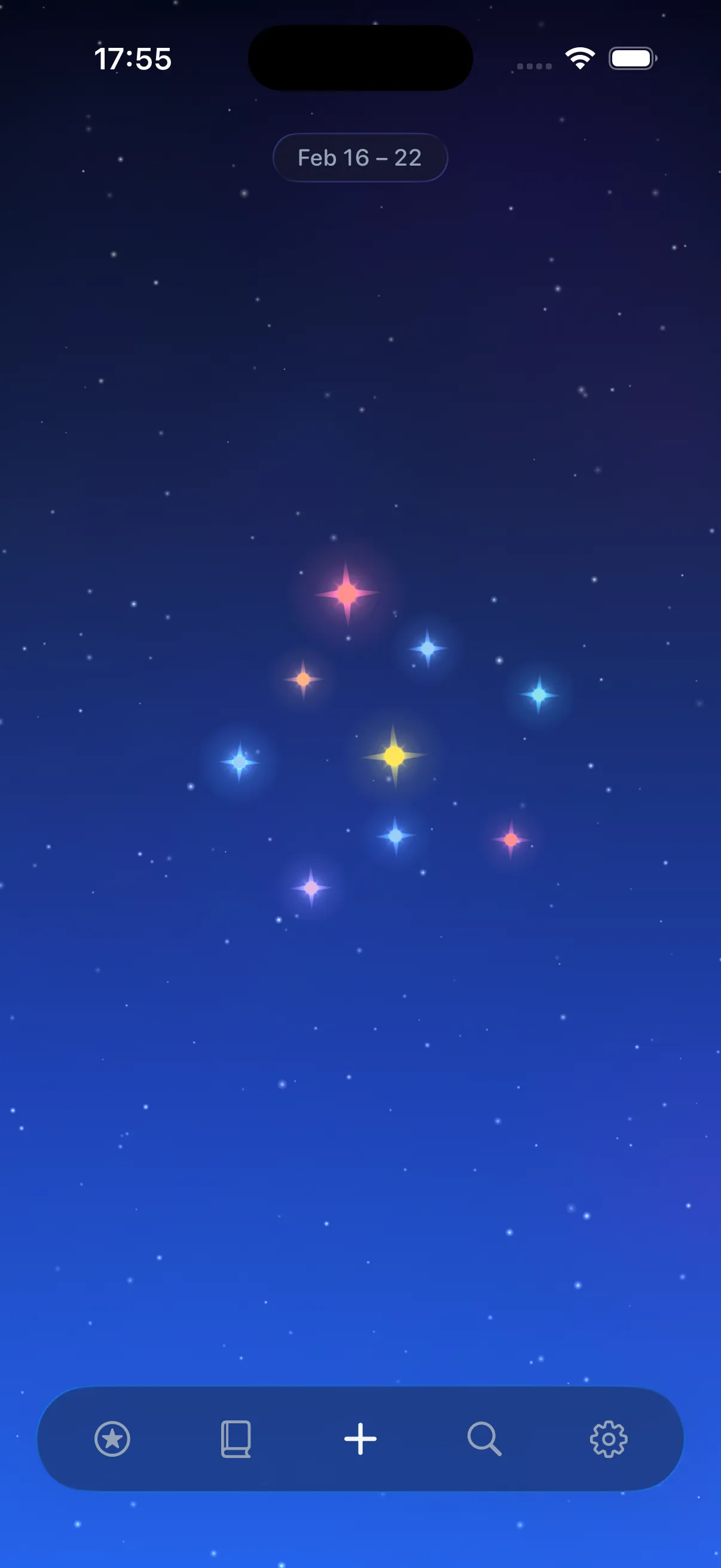
Turn your reflections into stars
Nightbook is a quiet journal for your evening thoughts. Every entry becomes a glowing star. Every week becomes a constellation.