Journaling App for Highly Sensitive People
Highly sensitive people who experience emotions, sensory input, and social dynamics more intensely than most, and who need a gentle, quiet space to process what they absorb each day.
Living as a highly sensitive person means carrying more than most people realise. A difficult conversation lingers for hours. A crowded room leaves you drained in ways others do not seem to experience. The emotional weather of the people around you becomes your own without your consent. By evening, you are often full, saturated with input that needs somewhere to go, and emotional regulation becomes less a skill and more a survival need. Nightbook was designed with the kind of care that sensitive people notice and appreciate. The dark interface is gentle on overstimulated eyes. The ambient sound is soft, not intrusive. The experience is minimal and calm, with nothing competing for your attention. It is a space that meets your sensitivity with gentleness rather than treating it as something to overcome. Our guide to journaling for self-compassion suits this kind of care, and the app fits naturally into a wind-down routine that honours your need to decompress.
Why journaling can feel hard
Overstimulating app design
Bright colours, notification badges, animations, gamification: most apps are designed to capture attention, which is the opposite of what a highly sensitive person needs at the end of an overwhelming day.
Absorbing others' emotions with no way to discharge them
HSPs often take on the emotional states of people around them. By evening, you may be carrying feelings that are not entirely yours, and without a way to process them, they accumulate.
Feeling \"too much\" in a world that values toughness
The cultural message is often that sensitivity is a weakness, something to manage or grow out of. This can make it difficult to find spaces that honour depth of feeling rather than trying to reduce it.
Difficulty unwinding after sensory overload
After a day of heightened input, the transition to rest does not happen automatically. A highly sensitive person often needs a deliberate decompression practice, not just the absence of stimulation.
How Nightbook helps
Dark-only interface
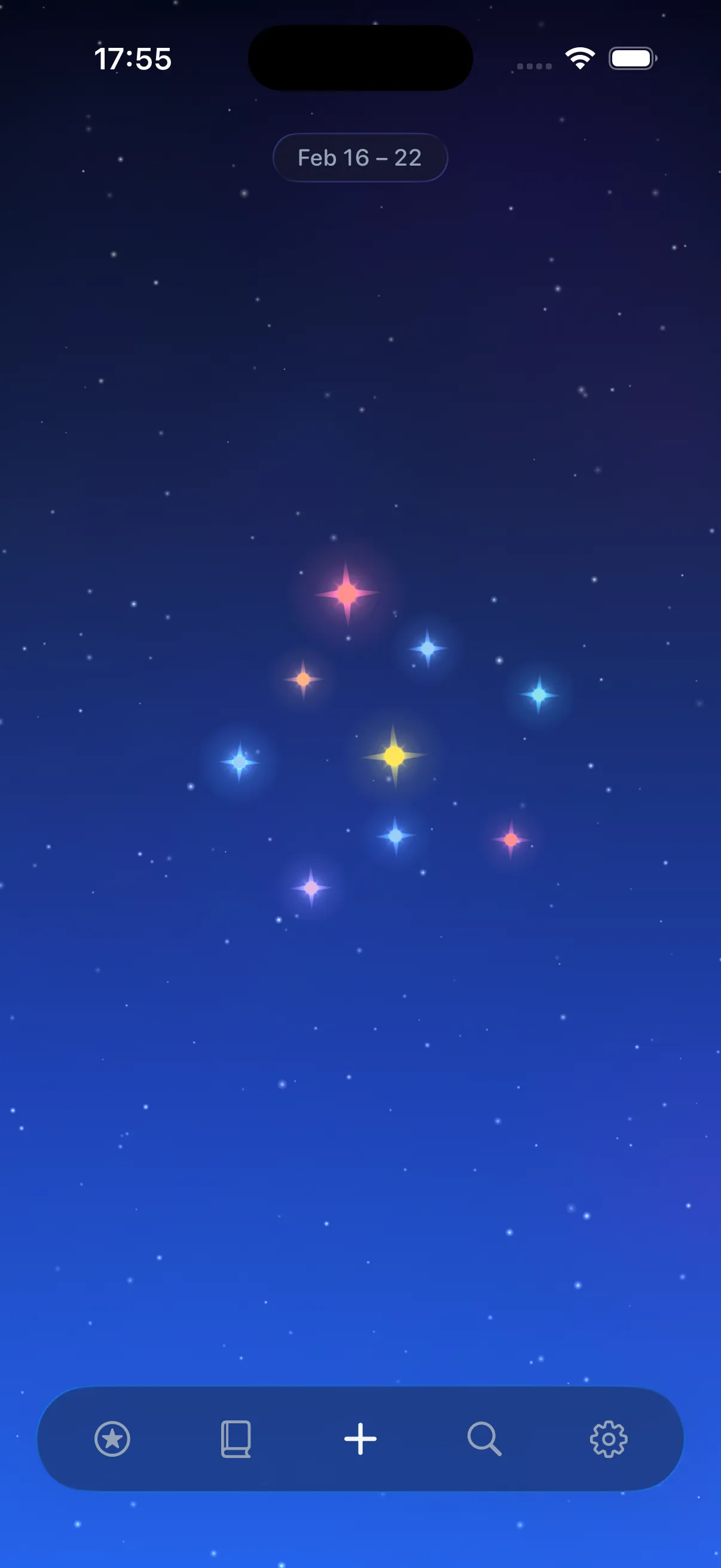
The dark, atmospheric design is visually quiet: no bright colours, no competing elements, no visual clutter. For eyes and a nervous system that have been processing all day, this gentleness is not aesthetic preference but genuine relief.
Ambient sound
The ambient audio provides a soft boundary between you and the silence, which for a sensitive person can sometimes feel too open after a loud day. It creates a cocoon of sound that supports decompression.
Every entry becomes a star
The bloom (visual, audio, and haptic) is designed to be satisfying without being overwhelming. It is a moment of sensory beauty that honours what you wrote rather than demanding more from you.
Deliberately minimal design
No prompts, no templates, no social features, no notifications beyond the one you set yourself. Nightbook does not compete for your attention or add to your sensory load. It simply holds space.
Your first night
Tonight, when the day has finally stopped asking things of you, open Nightbook. Turn on the ambient sound, let the dark screen ease your eyes, and try a little expressive writing about whatever you absorbed today. Let the page hold it so you do not have to carry it into sleep.
Keep exploring
For
Turn your reflections into stars
Nightbook is a quiet journal for your evening thoughts. Every entry becomes a glowing star. Every week becomes a constellation.