List Journaling
There is something clarifying about a list. It strips away the pressure of constructing sentences and lets you lay things down, one after another, each item given its own line and its own weight. List journaling takes this familiar form and turns it into a tool for reflection, memory, and quiet self-examination.
What it is
List journaling is the practice of writing journal entries in list form rather than continuous prose. Each entry is a numbered or bulleted collection of items, observations, feelings, or memories. The lists can be themed or open. You might list ten things you noticed today, five things you are worried about, three things you want to remember, or simply everything that comes to mind without a category. The power of the method lies in its simplicity and its surprising depth. Lists bypass the inner editor because they do not demand grammar, transitions, or narrative logic. Each item stands alone. And yet, when you read a list back, the juxtaposition of items often reveals patterns, priorities, and feelings that a more polished entry might obscure. The spaces between the items speak as loudly as the items themselves.
How it works
Choose a theme or leave it open
Themed lists have a specific focus: things that made you smile, sounds you heard today, questions you are sitting with. Open lists have no theme at all. Both approaches work. Themed lists go deeper into a single vein. Open lists capture the full breadth of your current state.
Write quickly, one item per line
Do not deliberate over each item. The speed and rhythm of listing is part of what makes the method effective. Write the first thing that comes, then the next, then the next. If you pause too long, you start editing, and editing is the enemy of honest listing.
Aim for a specific number or fill a page
Having a target helps. Ten items is a good default. The first five will come easily. The next five will require you to look harder, and that is where the interesting entries live. Pushing past the obvious is what separates a simple list from a revealing one.
Read the list as a whole
When you are done, read the list from top to bottom. Notice what you included. Notice what you did not. Notice which items carry the most emotional weight and which feel lighter. The list, read as a single piece, often tells a story you did not consciously intend to write.
Why it works
Eliminates the pressure to write well
Lists do not require sentences, paragraphs, or narrative skill. They require only honesty and attention. This makes list journaling one of the most accessible methods for people who feel intimidated by writing, or for nights when the energy for prose simply is not there.
Captures breadth rather than depth
Where other methods go deep into a single experience, list journaling spreads wide across many. A single list might contain a worry, a hope, a sensory detail, a memory, and a mundane observation. This breadth creates a remarkably complete snapshot of a moment in time, one that a focused essay could never match.
Reveals priorities through repetition
When you list freely over days and weeks, certain items reappear. The same worry. The same person. The same longing. These repetitions are not failures of imagination. They are signals from your subconscious about what matters most, what needs attention, and what is not going away on its own.
Putting it into practice
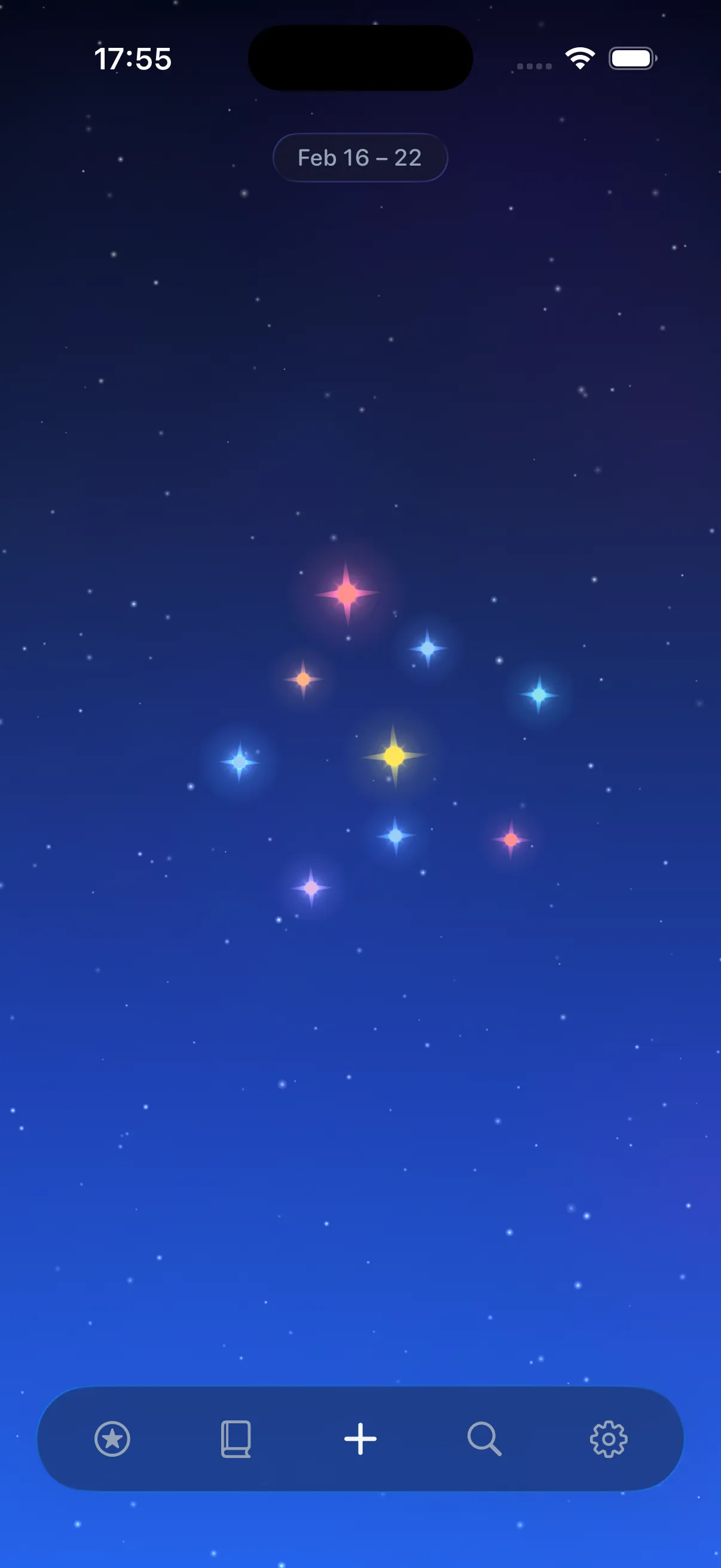
In the evening, when structured writing feels like too much, a list is always possible. Open Nightbook and write ten things, any things. They do not need to connect. They do not need to make sense together. What you will find, looking back over weeks of lists, is that they do connect, in ways that reveal who you are and what your days are actually made of. Each list becomes a star, and the constellation they form is a surprisingly honest map of your attention and your heart.
Prompts to try tonight
- ★ What are ten things I noticed today that I might otherwise forget?
- ★ What five feelings have I experienced in the last few hours?
- ★ What are three things I am looking forward to and three things I am dreading?
- ★ What would a list of everything on my mind right now look like?
- ★ If I listed the people I thought about today, who would be on that list?
Keep exploring
Methods
Benefits
Turn your reflections into stars
Nightbook is a quiet journal for your evening thoughts. Every entry becomes a glowing star. Every week becomes a constellation.